
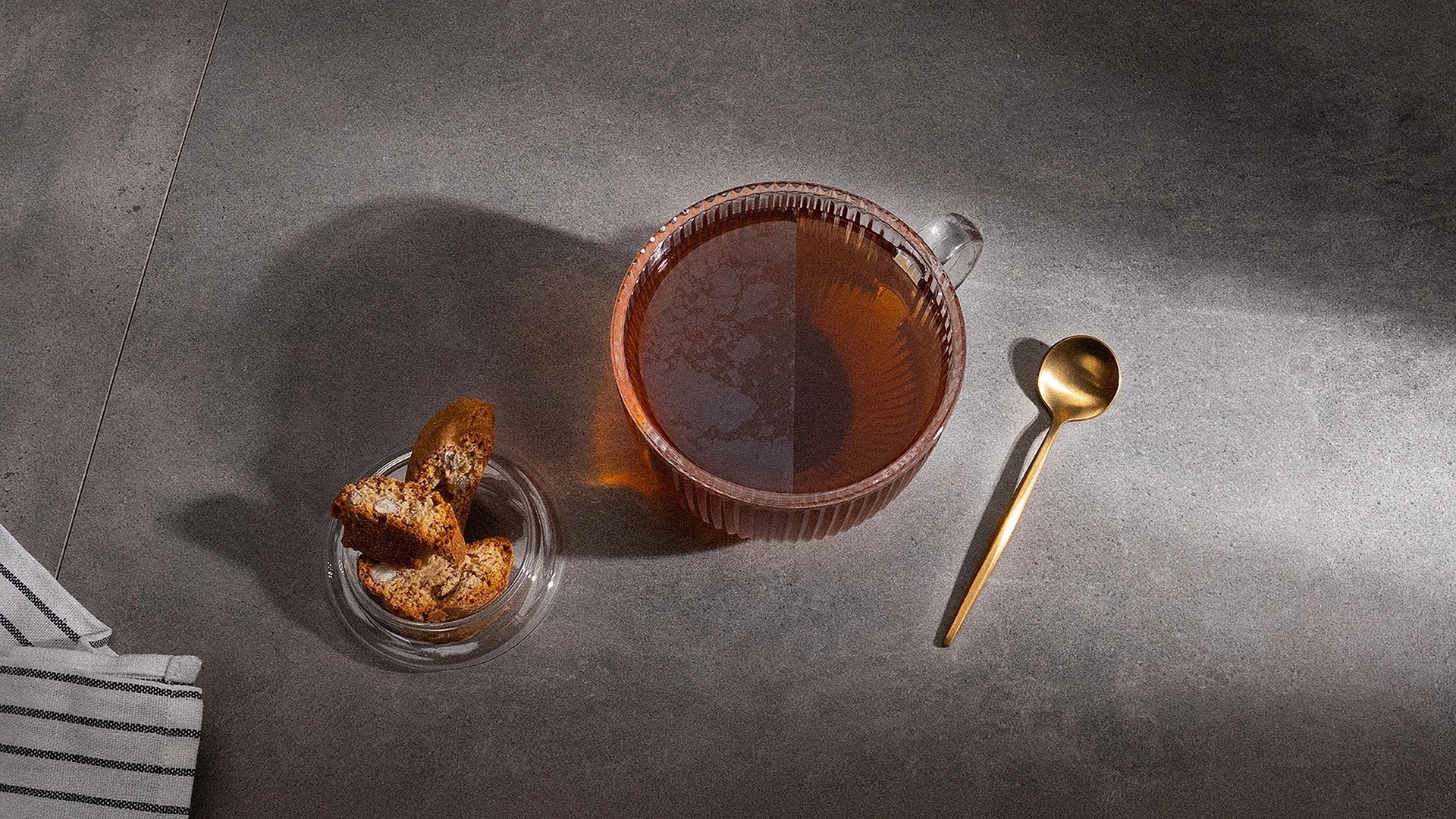
Tea stains lift with a paste of bicarbonate of soda and warm water – no harsh chemicals needed. The film on top of your tea has a different cause, and both have more to do with your water than with your tea.
━━━
To remove tea stains from cups, make a paste of bicarbonate of soda and a little warm water, rub it over the stain with a soft cloth or sponge, leave it for a few minutes, then rinse. Stubborn rings respond to a soak in warm water with a denture tablet or a splash of white vinegar. That is the fix. The more interesting question is why the cup stained in the first place.
Tea is rich in tannins – the polyphenols that give it colour and body. Tannins bind readily to surfaces, and they bind even more readily to the minerals dissolved in tap water. Calcium in particular acts as a bridge: it helps tannins anchor to porcelain and enamel. The result is the familiar brown ring – chemistry, not poor washing-up.
How much your cups stain depends on where you live and what you drink from. In hard-water regions, more dissolved calcium means faster, darker tea stains; in soft-water areas the same tea leaves barely a trace. Cup material matters too – unglazed or scratched surfaces stain sooner than smooth glaze.
Water hardness is the common thread – the same property that scales your kettle also marks your mug. What hardness actually is, and when it matters, is covered in Is limescale bad for you?.
What is the scum on tea?
Tea scum — the thin, oily-looking film that can form on top of a brewed cup – is not a fault in the tea. Scum on tea forms when tannins react with calcium carbonate at the surface of hot, hard water; a little air does the rest. Studies of scum in tea point consistently at water hardness: brew the same leaves with low-calcium water and the film largely fails to appear. It is harmless – but it mutes aroma and leaves that dull layer on the cup wall.
Preventing stains and scum – start with the water
Because calcium drives both effects, reducing dissolved calcium reduces both: less carbonate at the surface means less film, and fewer mineral bridges mean slower staining. Practically: rinse cups soon after use, avoid letting dregs sit overnight, and consider the water you brew with – particularly in hard-water regions.
Two minutes of cup care
A weekly bicarbonate wipe keeps glaze smooth and stain-resistant; a smooth glaze is the best passive protection you have.
━━━
Sources & further reading:
Science Direct (1)
Science Direct (2)
Nature
NHS
biologyinsights
PubMed Central
wikiHow
Last reviewed: July 2026


